
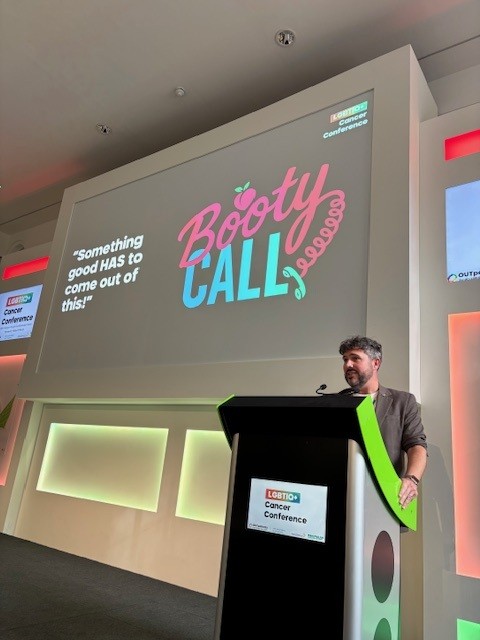
The OUTpatients National LGBTIQ+ Cancer Conference fell this year on World Radiography Day, Sunday 8 November, and brought together radiographers, clinical oncologists, medical physicists, patients, charities and other healthcare professionals from around the world.
Held at Woburn House in London, the event celebrated OUTpatients’ fifth birthday as a charity, with the theme of ‘Better Together: Improving cancer care through co-production’.
Attendees described the conference as a ‘testimony to what can be achieved when people with lived experience are given a meaningful voice alongside professionals and decision makers’.
'Empowerment, learning and togetherness'
Lynda Johnson, professional officer for clinical imaging and radiation protection at the SoR, said: “The first thing you feel when you enter an OUTpatients event is the warm welcome and the feeling of belonging. There are no barriers here and no hierarchies. The atmosphere throughout the day was one of empowerment, learning and togetherness.”
Stewart O’Callaghan, founder and CEO of OUTpatients – the UK’s only LGBTQI+ cancer charity – opened the conference by reflecting on their progress and the resources now available in for professional education and peer support.
During 2025, the OUTpatients team delivered 3,700 webinars, introduced peer support and grief sessions, ran surveys and worked with many other charities on several campaigns.
This has helped to educate healthcare professionals and to increase the confidence and reduce the fear for people undergoing cancer care.
Stewart reminded attendees that great progress has been made in the face of ongoing challenges and reflected that "the most influential rooms have the most closed doors."
Challenges in health services
OUTpatients welcomed the 10 Year Health Plan for the NHS and the focus on patient experience, but was disappointed in the lack of acknowledgement of the LGBTQI+ community in terms of underserved communities.
In September, alongside 15 other cancer organisations such as Bowel Cancer UK, Coppafeel, Out with Prostate Cancer and National Voices, OUTpatients wrote to the Secretary of State for Health and Social Care, urging inclusion of marginalised groups in the upcoming National Cancer Plan.
There remain challenges in UK health screening services, and work has been underway to develop a trans and non-binary screening booklet for GPs to ensure everyone has access to screening services and that people understand their individual risk profiles.
Areas that need improvement
Professor Lisa Blackman from Goldsmiths, University of London spoke about her personal experience of cancer care, explaining, “You can’t return to a pre-cancer self”, and added that cancer is a small part of a person’s identity.
She was not the only speaker throughout the day to describe a hyper heteronormative culture in cancer care, including repeated partner assumptions, making her feel like she’d gone back in time.
She reflected that pandemic protocols, including receiving her diagnosis over the telephone, had exacerbated these feelings.
Consequently, a creative arts research project was developed that enabled a diverse group of storytellers to highlight areas that require improvement for LGBTQI+ people living with and beyond cancer.
'Each of us as healthcare professionals has a duty'
Other inspirational speakers included Nancy Miranda Kelly, who revealed how she had felt like she was falling down a lift shaft when her clinician first asked her if she had children, and burst into tears while delivering her diagnosis.
She reiterated feeling like the cancer world insists on heterosexuality and is obsessed with hair loss, (a wild wig was produced that lightened the moment), but gave her no information about chemo-related menopause.
A common message throughout the day, although not experienced by all speakers, was that cancer care affects your feeling of safety as an LGBTQI+ person and can make you feel like you need to return to the closet to protect yourself.
Lynda added: “Each of us as healthcare professionals has a duty to stop that. The take-home message for me from Nancy was ‘if you can’t see our families, you can’t see us’.”
Programme and sessions
From Canada, Dr Amanda Bolderston and Kim Meeking presented the origins and work of the Queering Cancer Charity, whose mission is to advocate for inclusive cancer care for sexual and gender diverse communities.
Daniel Edwards, aka DJ Dallyn, entertained attendees with the fundraising exploits of the charity he set up following his experience of immunotherapy treatment: ‘Booty Call’ aims to turn the volume up on cancer awareness, and fund change for the LGBTQI+ community.
Workshops on young people with cancer, lead research and policy change, trans community-based research methods, co-production on improving outcomes for trans and non-binary people with cancer and rethinking health with Black and African queer community voices, as well as community toolkits for end-of-life and funeral plans, left the programme packed with information and engagement.
Models for co-creation
Finally, David Russo – founder of Cheeky Charity – ended the day with his co-creation model, ensuring ‘no butt is left behind’.
It focused on the principles of "going where the butts are", entailing meeting people where they are and speaking their language – cultural competency is not optional in health equity, he explained – as well as thinking 'polyamory not monogamy'. This meant connecting multiple partners in healthcare to amplify benefits, and measuring relationships in trust by leaving a positive impression.
Lynda continued: “Cancer is a journey nobody wants a ticket for, but as students, radiographers, nuclear medicine technologists, assistant practitioners, support workers, healthcare leaders, and educators, we can help to ensure no one has to pay more to travel first class.”
The SoR has produced a range of educational resources to support gender awareness training, which can be found here.
For more resources, information and education opportunities, get in touch with OUTpatients here.
(Image: OUTpatients LGBTIQ+ cancer conference, by Lynda Johnson)