
The first day of 2026’s annual UK Imaging and Oncology Congress (UKIO) began with detailed plenary sessions, opportunities for learning, and shared experiences of the profession.
Members of the SoR in attendance heard from experts across radiography specialties and departmental roles about innovation, technology and service delivery in the modern healthcare environment.
Beginning today (8 June), the conference will run through Wednesday (10 June) at the Liverpool Experience Campus, for three days of cutting-edge, practice-based content for a multidisciplinary audience and three days of continuing professional development.
'We will master the patient'
UKIO president and interventional radiologist Dr Shah Islam opened proceedings by welcoming all the attendees to this year’s conference, and explained his philosophy for the “relentless pursuit of excellence”, and how the four C’s – curiosity, challenge, change, and community – formed his approach as president of the congress.
“That’s what UKIO is,” he said. “A multidisciplinary community of radiographers, radiologists, and more. There’s nowhere else quite like it.”
Shah added that the growing attention on AI was one of the most significant developments in healthcare of the last few years, but that the technology could never replace the human element.
He said: “Love and forgiveness are two of the most important facets of the fabric that makes us human. Regardless of the views and analysis of an algorithm, it will never see what we see: a person, a family. There’s no doubt the algorithm will get better. Let the algorithm master the image – we will master the patient.”
'The best way to predict the future is to create it'
His introduction was followed by Professor Shafi Ahmed’s plenary session, ‘Intelligent: The evolution of AI transforming healthcare’. He discussed the history of AI in healthcare, its development, and its ability to affect the trajectory of humanity.
He said: “AI creates a lot of fear and anxiety. We need to strike a balance between innovation and human agency. The best way to predict the future is to create it. How do we deploy AI for our patients, in a way that is safe, effective and predictable?
“Healthcare isn’t ready [for AI]. It’s fundamentally broken – the systems don’t work. Can we open our minds to AI? We cannot be certain about our future with AI. Together, collectively, we need to figure out how to deploy it. How can we take control of our journey with AI as humans?”
Throughout the day, informative lectures ran alongside parallel learning sessions, which focused on everything from digital technologies to practical skills and workforce support.
'Are we a future-ready workforce?'
Later in the day, Professor Ric Khine delivered the eponymous SoR Martine Jackson Memorial Lecture: ‘Shaping the future of cancer care - the expanding horizons of therapeutic radiography’.
SoR presidentKatie Thompson chaired the session and explained the impact of Martine Jackson’s work as a radiographer, and how the eponymous lecture is delivered each year by someone who has put the patient experience at the heart of care and who is raising the bar for radiotherapy.
Ric sought to explain the need to expand and improve radiotherapy services in the face of workforce crises and financial challenges, the need to centralise and simplify funding streams, and the changes in the healthcare landscape – namely, from treatment to prevention.
He said: “Colleagues, a new era is upon us. We need to develop modern, multiprofessional cancer care that embeds innovation, so we can ensure this translates into high-quality care for our patients. At the centre of this transformation are Therapeutic Radiographers and the radiotherapy profession.
“Are we a future-ready workforce? The way care is delivered is evolving quickly. The education landscape is changing rapidly as well. What does that mean for our patients? For me, it provides assurance to our patients that radiotherapy is a valuable profession with highly skilled, trained experts who are adaptive, reflective, competent practitioners.”
Reflecting on the opening day of the conference, Rachel Nolan, SoR president-elect, said: “It’s amazing to see the number of people who have turned up, it seems like every year there’s more and more. We’ve had great speakers, particularly Ric Khine. Everything he said really resonates with radiographers, both diagnostic and therapeutic.
“I’m particularly looking forward to the session about the launch of the 4Ps document, and all the sessions that have focused on the patient voice. It’s an excellent experience to hear from the patients, and that’s something I’ll be carrying through to my term once I start as president.
“I would recommend everyone really try and find the time to come along to UKIO at least once in their career. There’s always something for everybody."
QSI Standards update
During the joint College of Radiographers and Royal College of Radiologists session on the Quality Standards for Imaging, attendees heard about the rigorous review of the system and the introduction of two new areas around artificial intelligence and machine learning, and sustainability.
Alexandra Lipton, professional officer at the SoR, explained that this is the fourth significant review of the QSI since its inception, as part of efforts to ensure it is patient-focused and applicable to all four nations and all services.
The requirements have been standardised and streamlined to ensure each one is easy to understand and reflects growing areas of focus in professional practice. These standards will be accessible from September this year, but will only be implemented from April 2027.
Collaborative Ultrasound Manifesto
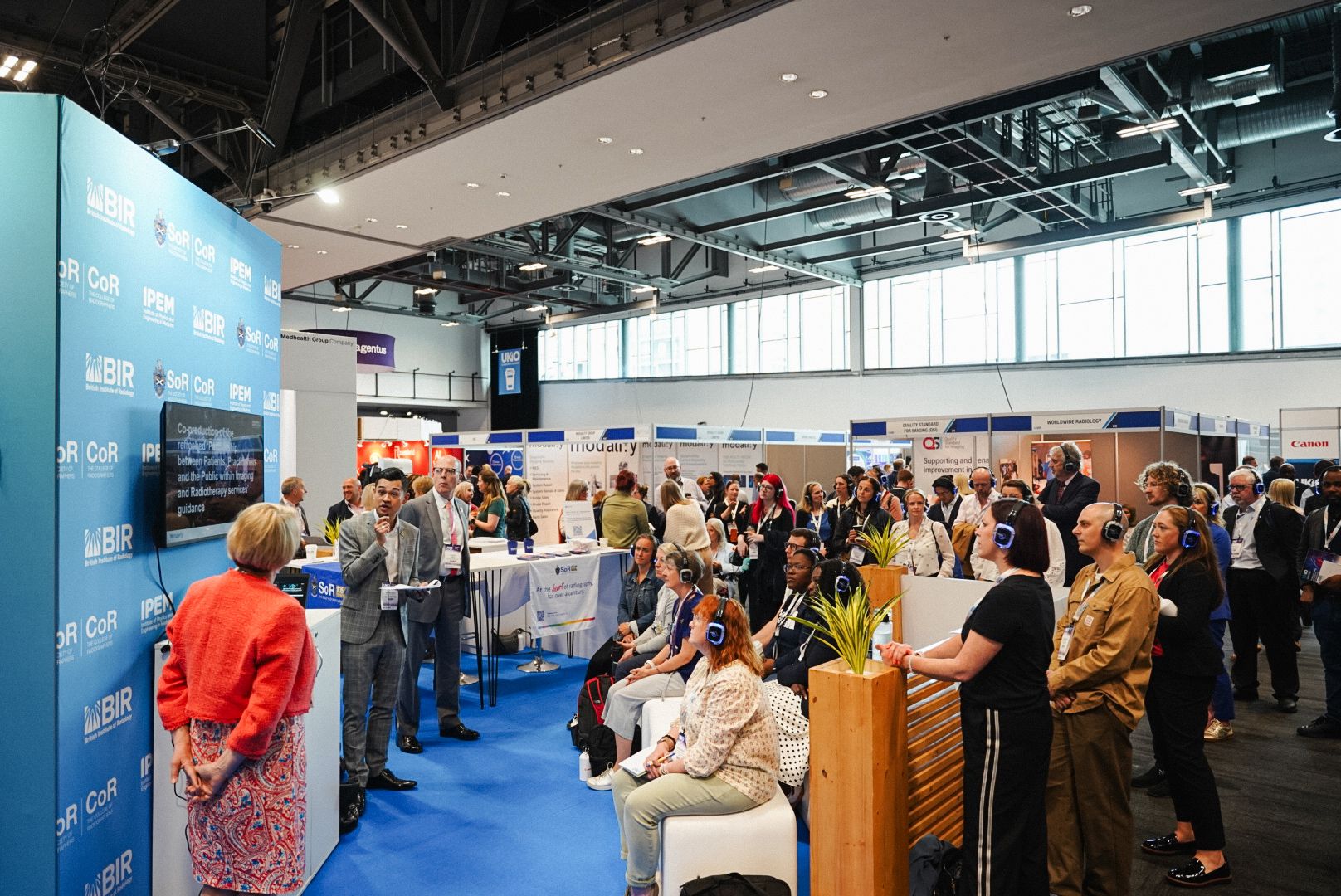
Day one closed with the launch of the Collaborative Ultrasound Manifesto on the SoR stand, where Katie was joined by representatives from the British Institute of Radiology and the Institute of Physics and Engineering in Medicine.
Together, the presenters explained that ultrasound is a specialty that is both evolving rapidly and is involved with a broad range of patient pathways.
Katie said: “Those of you working in ultrasound will be well aware of the challenges we are facing. We continue to face the absence of statutory regulation and a lack of funding for education and the workforce. The current model is not sustainable. We need a workforce that is supported in the face of the physical and emotional challenges we face every day.
“Statutory regulation matters. It enables more training routes into the profession, supports recruitment and retention, and ensures patient safety. Not only must we recruit new sonographers, but we must also support the workforce we already have. Too many colleagues are working under pressure, risking burnout or facing the risk of musculoskeletal injury. There is also too much inconsistency, regionally and nationally, around progression and promotion, and that creates inequity across the profession. That’s why this manifesto is so important.”
The manifesto calls upon national decision-makers, professional bodies and healthcare organisations to work together to:
- Stabilise and expand the ultrasound workforce through statutory regulation, protected training capacity, and national workforce planning
- Invest in lifelong skills development
- Embed robust asset management, clinical audit and QA systems
- Adopt innovation safely and consistently
- Provide sustainable, multi-year funding to underpin training, QA and equipment replacement
- Deliver a unified national ultrasound strategy that reduces variation and improves outcomes across the UK
UKIO continues on Tuesday (9 June). Find out more about UKIO, and access the full programme, online here.
(Image: UKIO 2026 day one, by Eva Slusarek)