
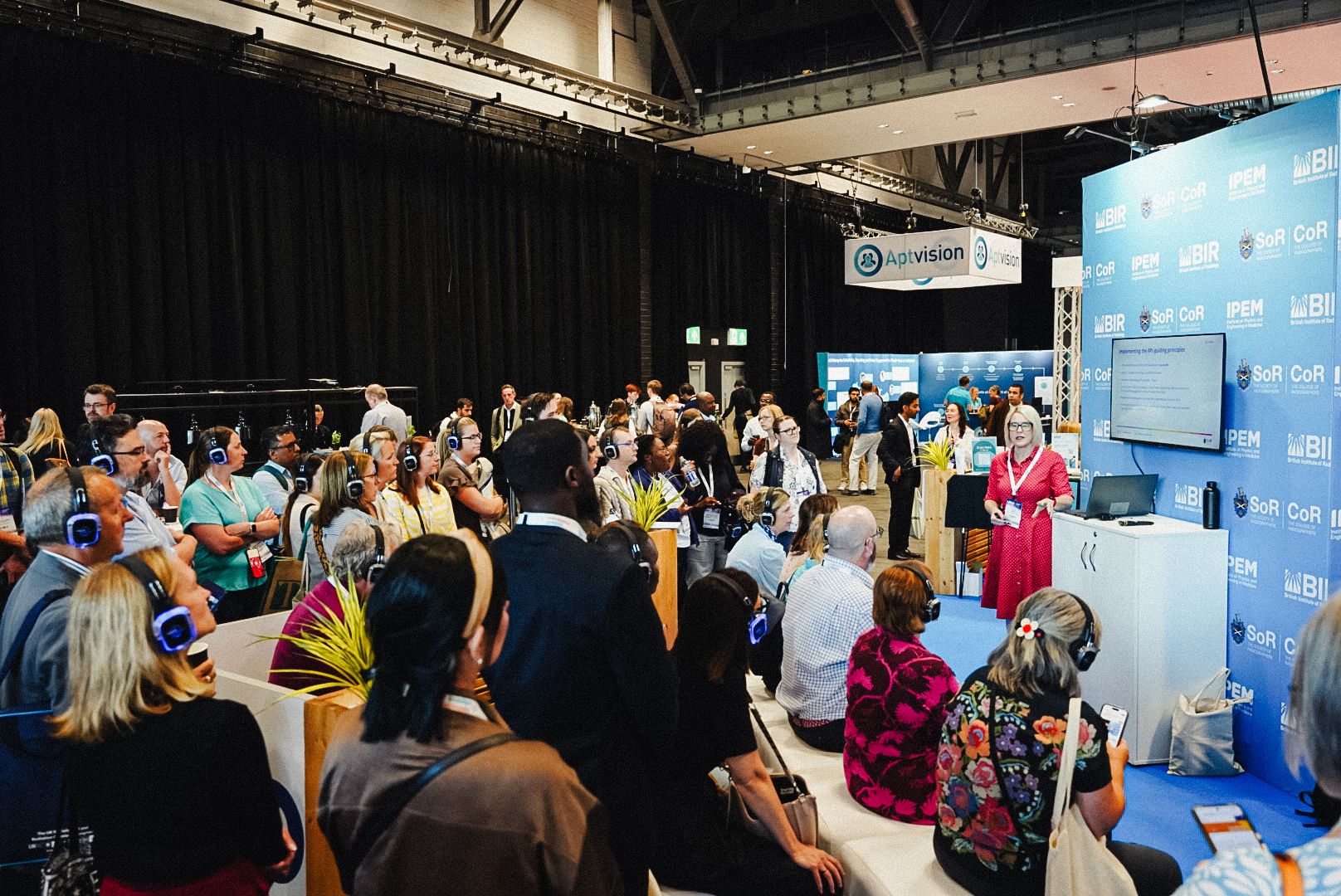
The second day of the UK Imaging and Oncology Congress (UKIO) saw attendees gain valuable insights into the evolution of the radiography profession, and into mentorship and leadership skills.
From the opening plenary session on AI to demonstrations of cutting-edge technology, the second day of the three-day conference offered a stacked programme covering the entire spectrum of medical imaging and oncology.
UKIO takes place from Monday, 8 June to Wednesday, 10 June at the Liverpool Experience Campus, for three days of continuing professional development and practice-based content targeted to a multiprofessional audience.
'Shiny toy syndrome'
Tuesday’s programme opened with a welcome from UKIO president Dr Shah Islam, followed by a panel of AI experts on the main stage for the 'Signify Research Presents: The AI in imaging paradox' plenary. The assembled speakers were asked one simple question: has AI in imaging been an expensive failure or a necessary prerequisite?
Catherine Jones, consultant radiologist at the I-MED Radiology Network, said: “Increasingly, we talk about the return on investment as the reason to purchase a new tech tool, particularly an AI tool. But part of that return on investment is the benefit to the patient, not just a financial return. Why does a technology have to be cost-neutral? Performing medical imaging for the right patient, with the right reason, at the right time, returns a health benefit.”
Catherine was joined by Steve Holloway, co-founder and CEO of Signify Research; Simon Rost, chief marketing and strategy officer at GE HealthCare Germany; Chad McClennan, CEO of Koios Medical; Dr Rizwan Malik, managing director of SMR Health and Tech and Graham King, AI Special Focus Group convenor at AXREM.
The speakers also suggested AI adoption had ‘leapfrogged’ the impactful, low-risk uses of AI for the back-office functions, and now suffered from “shiny toy syndrome” by trying to find a use in radiology. Instead, they suggested, institutions should look into using AI for less visible elements of the patient pathway, such as billing and scheduling.
Constant vigilance
To kickstart the afternoon, consultant radiographer Dr Nick Woznitza led the second of the SoR’s eponymous lectures, the William Stripp Memorial Lecture.
Katie Thompson chaired the session and explained that William Stripp was well known for his orthopaedic work and his teaching skills. He wrote many scientific papers and practical guides.
Dr Woznitza provided an overview of the evolution of radiographic practice, ‘from Roentgen to robots’. He explained the process of discovery of X-rays, and the subsequent developments in healthcare that led to the creation of a new Allied Healthcare Profession: the radiographer.
He said: “The journey of the radiographer is one of the most dynamic in modern healthcare. We’re at the forefront of technology, and always have been. We are now in the fifth industrial revolution – that of artificial intelligence. Even though the pace of development is rapid, we are slowly starting to see adoption into practice. The requirement now is one of constant vigilance. We need to be the voice fighting for these changes."
Emma Hyde, head of education and research at the SoR, said that the atmosphere of the conference was 'fantastic', and recommended members come along whenever possible.
She added: "There's a real buzz in the air, and the day has been really engaging and constructive. There have been so many great discussions on where the profession is heading. This afternoon, I attended a session on education in the workforce that looked at generational differences, focusing on what everyone can learn from each other.
"We've had great engagement on the launch of the refreshed 4Ps document, on the QSI review, and on the mentorship schemes, both for research and leadership. Anyone who wants to should come along and try out the conference. We might see you presenting next year!"
Research and mentoring schemes
Day two of the conference closed with updates from the SoR on the impact of its leadership and research mentoring schemes.
Chaired by the SoR's executive director of professional policy, Charlotte Beardmore, the session focused on the impacts of the Society's Formal Radiography Research Mentoring (FoRRM) and the Learning Mentorship Scheme (LMS).
Chidi Ollawa and Amanda Riley, both recent graduates of the FoRRM and LMS schemes respectively, shared their firsthand experience of the schemes.
Amanda said: "So one of my main motivations for joining the program was the sense that opportunities within my current role felt increasingly limited, and at times misaligned with the type of work and impact I wanted to have.
"I wanted to better understand what leadership or strategic roles might align with my values and preferred way of working, whilst also supporting a healthier and more sustainable work-life balance, so my objective is really centered around three areas: developing my confidence as a leader, exploring future opportunities beyond pure and clinical, and building a clear understanding of my own leadership style, strengths, and values."
UKIO continues on Wednesday (10 June). Find out more about UKIO, and access the full programme, online here.
(Image: UKIO Day 2, by Eva Slusarek)