
NHS patients with dementia are being mislabelled as 'aggressive' and 'violent' because hospitals are failing to meet their needs, the Society of Radiographers has said.
In a motion presented at its Annual Delegates’ Conference, held in London this week, the SoR called on the NHS to do more to reduce stress for patients with dementia.
The motion states: “People living with dementia often face barriers in X-ray departments due to sensory overload, unfamiliar environments and communication challenges. Adjustments such as quiet spaces, adaptable lighting, clear communication and staff awareness can significantly improve patient experience and outcomes.”
'A sign of unmet need'
Lisa Booth, a senior lecturer at the University of Cumbria, researches patient care in radiography. She points out that patients with dementia struggle to process information.
“When you take them into an unfamiliar environment – with unfamiliar voices, faces and noises – that requires a lot of processing,” she says. “And then the patient becomes really overloaded.
“Alzheimer’s affects the logical part of the brain first. So people can’t say, ‘I can’t cope with this – I need some space.’ Instead, fight-or-flight instinct kicks in. When somebody can’t tell you that they’re in pain, they act out non-verbally, behaviourally. Then, healthcare workers say, ‘dementia patients are aggressive,’ but not ‘let’s take a step back and look at what in the environment is creating that response.’ Those behaviours are a sign of an unmet need.”
There are currently estimated to be 982,000 people with dementia in the UK – a number that is expected to rise to 1.4 million by 2040.
Stressful and challenging
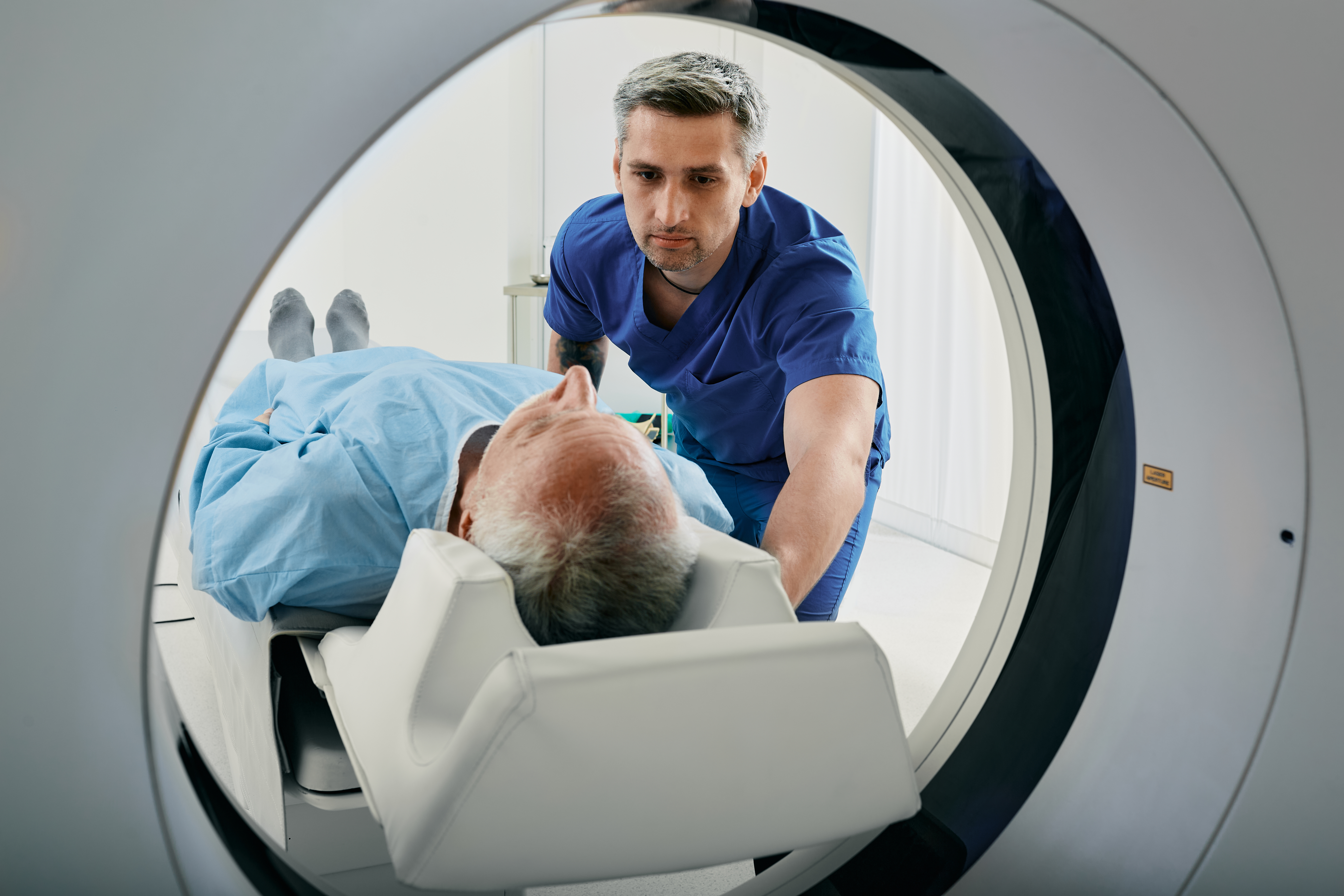
Dr Booth points out that when a patient goes for an X-ray examination, scan or other diagnostic test, there may be three or four people in the room. This can feel overwhelming to someone with sensory-processing issues.
Patients will then be given instructions such as: “Could you get up on the table, please, and lie on your left side, with your head on the pillow?”
“A patient with dementia can’t process all that,” Dr Booth says. “You have to start with ‘Please get up on the table,’ then give them time for that information to sink in and think about the response. Yes, it takes time. But it gets better results.”
Dr Booth also says that hospital waiting rooms could be made less stressful to patients with dementia, so that they are not in a state of overwhelm before they even set foot in the exam room. This can be as simple as replacing abstract art, which can be challenging for people with processing disorders, with pictures of nature.
But the most important step healthcare workers can take, Dr Booth says, is to refer to the patient’s dementia in their notes for other NHS staff, and to include any approaches that have helped the patient to relax. This will ensure that the next member of staff is able to meet their needs quickly and prevent overwhelm.
Bespoke care
Emma Hyde, SoR head of education and research, emphasises the importance of adapting to the needs of patients with dementia. The SoR has recently published a patient-consent flowchart, designed to check whether patients with dementia have the capacity to consent to scans or treatment.
But, Dr Hyde adds, all patients – whether or not they have dementia – benefit from similar bespoke care. The Society and College of Radiographers will be launching guidance in the summer that will emphasise the importance of tailoring care for all patients.
“It’s about tailoring it to the individual,” Dr Hyde says. “A lot of these things are about fundamental human connection: providing care that’s dignified and respectful for people. It doesn’t take much time: to say, ‘Hello, my name is –’ or to provide someone with time to ask questions.
“Taking those extra few seconds can make a huge difference to the outcome of their examination or treatment, so it’s absolutely crucial for us to be doing it.”
Find out more about ADC online now.
(Image: Photo by peakSTOCK, via Getty Images)