
By Jeanette Carter, SoR professional officer for AI and digital technologies
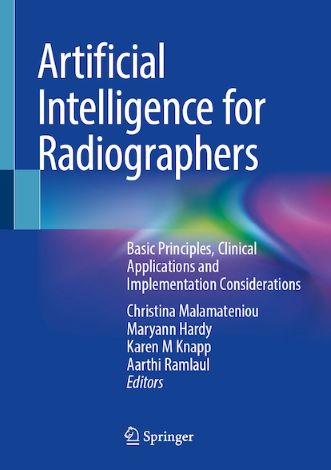
Artificial Intelligence for Radiographers, edited by Christina Malamateniou, Maryann Hardy, Karen Knapp and Aarthi Ramlaul and published by Springer, was released earlier this year and has already had more than 9,000 downloads.
This is a book that was required and it has been well put together by the editors, with more than 100 contributors spanning multiple areas of radiography and AI, with a 50:50 split of males and females. The book offers a stepping stone into the world of AI for radiographers with an overall aim, that was discussed with the editors when I was fortunate to sit down and talk with them, to be used by educators as an educational tool for AI.
This book, I feel, is an essential purchase for all healthcare and educational providers – not only for radiographers, both diagnostic and therapeutic, but also for other AHPs. As Christina discussed, the areas of AI methodologies, principles, ethics, person-centred care, industry and the future of AI are all very much relevant to all healthcare professionals as well as radiographers.
This book has a chapter for each element of AI in the world of radiography so, if there is a specific area you want to learn more about, you can go straight to the relevant section. Furthermore, there are chapters on each modality separately and radiotherapy, ensuring the specific areas of focus are available and understood. This book has not been written to be read cover to cover but to be consulted on the area you require at a particular time. However, there are also chapters for all, a personal favourite being the chapter on person-centred care.
So why was the book written?
Christina said that AI became part of her world, whether she liked it or not. She was put into the world of AI when doing her PhD and then learned AI, in her words, backwards – practical and then theory. From this, when joining City, University of London, she wanted to do an interactive course for radiographers in AI, which was being planned in 2019 but then 2020 and the pandemic happened. She then started conversations with Karen, Aarthi and Maryann after the Society of Radiographers published an AI statement and it was felt like a book was required. COVID might have paused it slightly but in 2021 the journey of the book began.
Maryann mentioned a story about listening to a talk at ECR around AI and asking the question: “What about the radiographers in all this?”, which led to silence and the realisation that radiographers hadn’t been thought about. From this, she wrote her first paper on AI for radiographers with Hugh Harvey. This further highlighted the need for this book, making radiographers feel part of the story of AI in radiology and oncology.
An acknowledgement was made to this book being a little late to the table as radiographers were busy advancing technologies and not thinking about leading on this technology.
What do the editors want the reader to get out of it?
The editors said they wanted to give people confidence and a baseline, not only for students but also for educators to inspire the next generation. To give educators a book to use chapter by chapter to produce an educational module. Aarthi added that she would like this book to bridge the gap and demystify AI whilst demonstrating how it can enhance practice. Karen said she wants the reader to have confidence in the language of AI and to be able to develop the tools of the future as well as use them. Christina explained that she wanted this book to also acknowledge the risk, arming readers with the knowledge of the early risks, to question the AI response and understand the errors. From reading this book, I can honestly say that it does all of this.
Christina went on to explain that everyone has the responsibility to learn about AI and how it changes over time: “We have a responsibility to produce structures to safeguard human reasoning, always having the human in the loop or how do we integrate AI into the loop.”
This book, I feel, not only be of value to students and educators but also to radiographers in practice.
What other chapters could there be in future editions?
This led to a great discussion and highlighted the extensive growth of AI that needs to be kept up with. It is worth noting at this point that the authors worked until the last minute to ensure that it was as up to date as possible, particularly in the further reading section, to ensure it included all the latest papers at the time of publication.
Christina discussed chapters on gen AI, LLMs and agentic AI as well as useful tools regarding AI in education, which Aarthi agreed with, as well as AI literacy, which “is often a barrier rather than an enabler”. Aarthi and Maryann discussed a need for chapters on leadership, giving them confidence and explaining how to implement, make or create pathways and how to integrate whilst accepting their own vulnerability. Karen further went on to explain the need for more on pathway modelling and how we rethink our services with AI to address the problems we currently have. AI has the power for us to do things differently.
This book is fully evidence based and is proud to share research led by radiographers and MDTs, mainly in the UK. Even though some chapters, particularly the early ones, can feel like they provide quite a lot of information, this book will give you the guidance required to help radiographers and health professionals through the world of AI in radiography.
As already mentioned, this book should be available in all hospitals and healthcare education providers at a minimum. For anyone wanting to gain more of an understanding of AI in radiography and what it can do, this book comes highly recommended.
I can say personally I have already used this book on multiple occasions for varying conversations and presentations. It is great to see such a comprehensive book written by and for radiographers about such an important topic.
Upcoming SoR AI guidelines and webinars
Look out for new SoR AI guidelines addressing the scope, purpose and implementation of AI strategy in UK healthcare and in enabling person-centred care. The SoR is also launching a series of AI themed webinars early in the new year, including examining the use of AI in clinical practice and education.