
Written by Saraaz Khalil
During this year’s Ramadan, the Society of Radiographers is celebrating and amplifying the experiences of radiographers who observe the holy period.
Ramadan, the ninth month of the Islamic calendar, is a month-long religious festival observed by Muslims as a month of fasting and prayer.
Saraaz Khalil, an interventional radiology specialist at Leeds Teaching Hospitals NHS Trust and an allied health professional (AHP) & nurse/midwifery practice educator, shared his experience of being a radiographer during Ramadan.
Saraaz Khalil
"I specialise in interventional and cross-sectional imaging, with experience across CT (including Cone Beam CT), general radiology, fluoroscopy, theatre imaging, and specialist pain and neurostimulation procedures & Education.
Alongside my clinical role, I am deeply committed to education and professional development. I am the founder of RadGuide, an educational platform supporting radiography, AHP, medical and dental students, and author of the Radiography Survival Guidebook, having mentored over 1,000 learners nationally.
I actively contribute to national policy and professional development through roles with the Society of Radiographers, including serving as Yorkshire & Northern study officer and UK representative for the Diagnostic Imaging Advisory Group. I am also an associate peer reviewer for the Journal of Medical Imaging and Radiation Sciences, and many more.
My work focuses on advancing patient-centred care, promoting artificial intelligence in medical imaging, championing British Sign Language (BSL) integration in healthcare, and supporting quality improvement initiatives aligned with guidance from the Royal College of Radiologists.
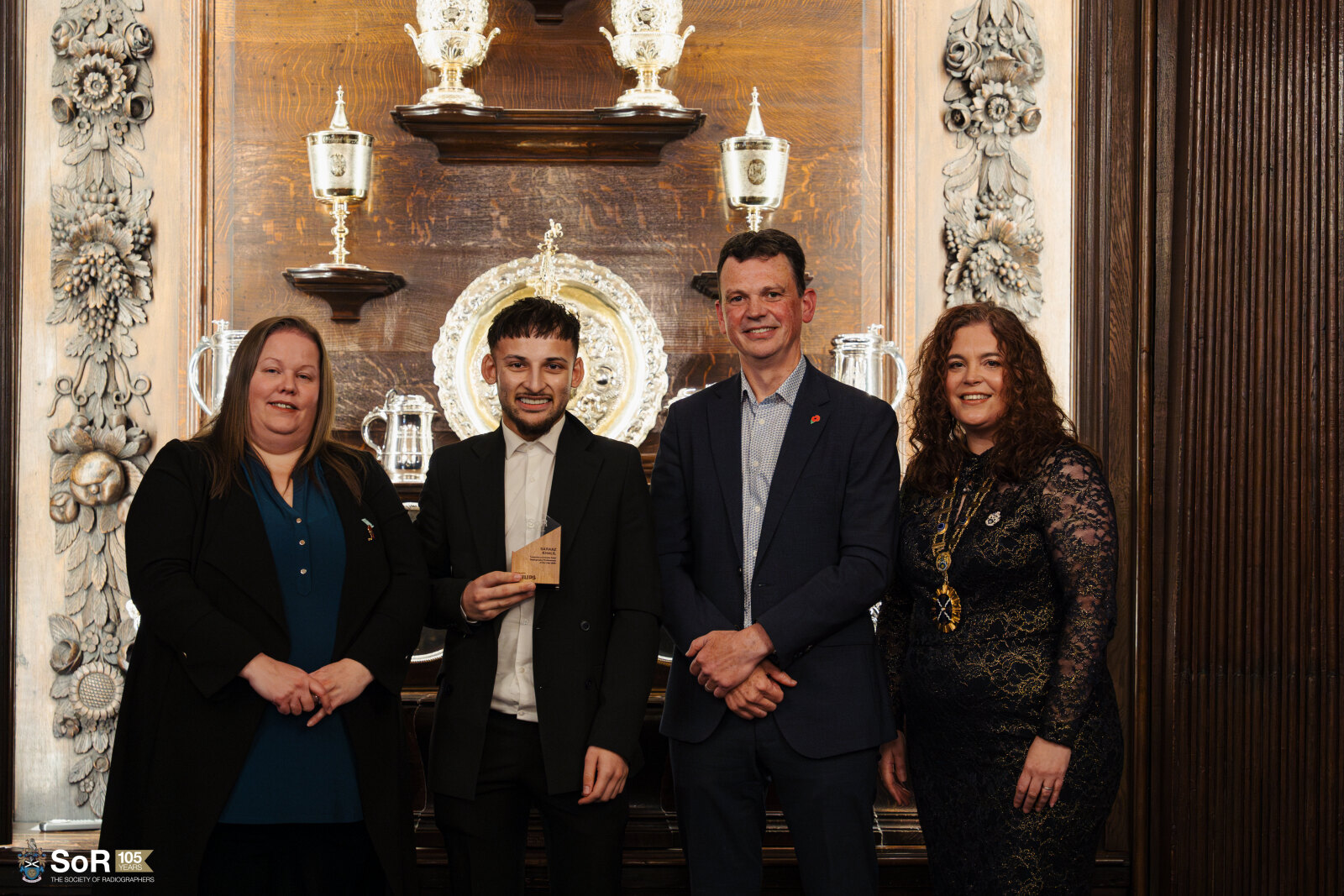
In 2025, I was honoured to receive the Yorkshire & Northern Radiology Professional of the Year Award, recognising my contributions to clinical practice, education, and advocacy within UK radiography.
What first inspired you to join the radiography profession?
What first inspired me to join the radiography profession was the unique combination of science, technology, and direct patient impact.
I was fascinated by how imaging allows us to visualise anatomy and pathology in real time — not only to support diagnosis, but to improve patient outcomes through precision and clarity. Early in my journey, I developed a particular interest in dental radiology and ultrasound, both of which demonstrate how highly skilled imaging can directly influence clinical decision-making in a focused, patient-centred way.
Dental radiology especially intrigued me because of its precision, technical nuance, and the important role it plays in preventative care and treatment planning. Similarly, ultrasound education stood out to me because of its dynamic, hands-on nature — it requires deep anatomical knowledge, strong clinical reasoning, and excellent communication skills. The ability to both perform and teach ultrasound felt like a powerful way to bridge technical expertise with education.
Alongside this, I became increasingly passionate about widening access to knowledge and supporting learners. Founding RadGuide and mentoring students across radiography, AHP, medical, and dental programmes has allowed me to nurture confidence and competence in the next generation of professionals.
Radiography inspired me because it blends innovation with human connection — and my focus on dental radiology and ultrasound education reflects my commitment to precision, prevention, and empowering others through learning.
What aspects of Ramadan are meaningful to you, and how do they influence your work as a radiography professional or learner?
As an educator, Ramadan is deeply meaningful to me because it represents reflection, discipline, service, and intentional growth — all values that strongly align with my professional identity.
Ramadan teaches self-discipline and resilience. Fasting requires focus, emotional regulation, and patience — qualities that are equally essential in healthcare education. Whether I am mentoring students, delivering teaching sessions, or supporting learners in clinical environments, Ramadan reinforces the importance of maintaining professionalism, compassion, and consistency, even when physically challenged. That self-awareness strengthens how I show up for my learners.
It is also a month of reflection and accountability. As an educator, I regularly reflect on my teaching practice — asking whether I am inclusive, accessible, and genuinely meeting learners where they are. Ramadan amplifies that reflective mindset. It reminds me that education is a responsibility and a trust, much like patient care.
Another meaningful aspect is empathy. Experiencing hunger and fatigue increases my sensitivity to vulnerability, which directly influences how I support students who may be struggling academically or personally. It encourages me to create psychologically safe learning spaces, to check in more intentionally, and to promote wellbeing alongside performance.
Ramadan also emphasises community and service. In education, that translates into mentorship, widening participation, and ensuring learners from diverse backgrounds feel represented and supported. It strengthens my commitment to equity — whether that is advocating for inclusive teaching practices, supporting accessibility, or ensuring faith and cultural awareness are respected within clinical environments.
Ultimately, Ramadan enhances my leadership as an educator. It grounds me in humility, reinforces integrity, and reminds me that impact is not just measured in outcomes, but in how we uplift others along the way.
What's your daily routine as a radiography professional or learner during Ramadan?
During Ramadan, my routine is intentionally structured around worship, discipline, and professional focus.
I wake up for Suhoor, pray Fajr, and spend time reading Qur'an. That early morning period is the most grounding part of my day — it allows me to centre myself spiritually before any professional demands begin. After prayer and reflection, I formally begin my fast and dedicate around two hours to focused study. This is usually academic reading, educational planning, or development work related to radiography, dentistry, or ultrasound education. The quiet of the early morning significantly enhances concentration and retention.
After this study block, I prepare for work. In clinical or educational settings, I remain mindful of energy management while maintaining high standards of patient care, teaching, and mentorship. Ramadan reinforces intentionality — I communicate clearly, pace myself effectively, and ensure that both learners and patients feel supported.
Once I finish work, I break my fast at Iftar and pray Maghrib. I then go to the gym, which helps maintain both physical discipline and mental clarity. Exercise during Ramadan strengthens resilience and reinforces the importance of balance.
To close the day, I dedicate an additional two hours to study and reflection. This may include reviewing clinical material, contributing to educational content, or engaging in reflective practice aligned with professional development. I end the night with spiritual reflection, ensuring the day concludes with gratitude and purpose.
Overall, Ramadan structures my day around faith, growth, and consistency — strengthening both my professional performance and my role as an educator.
How are you celebrating Eid?
I celebrate Eid as a time of gratitude, family, and reflection after a month of discipline and spiritual growth.
The day begins with the Eid prayer at the mosque, which is always a powerful reminder of community and unity. It's a moment of collective gratitude — seeing people from all walks of life come together reinforces the values of service and humility that also guide my work in healthcare education.
After prayer, I spend time with family, sharing meals and reconnecting. Eid, for me, is about presence — being fully engaged with loved ones after a month of structured routine and fasting. It's also a time to give back, whether through charity, supporting community initiatives, or simply checking in on those who may be isolated.
Last year was slightly different — I was on night shifts in A&E over Eid. While it meant missing parts of the traditional daytime celebrations, it was also a powerful reminder of the vocation of healthcare. Serving patients during a time that is personally significant reinforced my sense of duty and gratitude. Healthcare doesn't pause for celebration, and being present for patients during Eid deepened my appreciation for both my faith and my profession.
Professionally, Eid is also reflective. I use it as a milestone — assessing what I've learned during Ramadan, both spiritually and personally, and how that growth translates into my role as an educator and radiography professional. It's an opportunity to reset intentions, refine goals, and carry forward the discipline and empathy strengthened over the month.
Ultimately, I celebrate Eid with gratitude, community, and a renewed commitment to service — both within my family life and in my professional responsibilities.
Anything else you'd like share?
I would add that for me, faith and profession are not separate identities — they inform one another.
Ramadan and Eid remind me that excellence is not just about technical competence, publications, or awards; it is about intention, integrity, and impact. As an educator and radiography professional, I strive to model balance — demonstrating that you can pursue high clinical standards, academic ambition, and leadership while remaining grounded in humility and service.
I am particularly passionate about representation in healthcare. Visibility matters. Whether it is advocating for inclusive practice, widening participation, supporting learners from underrepresented backgrounds, or promoting accessibility, such as British Sign Language in healthcare settings, I believe leadership carries responsibility beyond personal success.
I also hope that sharing my journey — including working nights in A&E during Eid, maintaining study discipline throughout Ramadan, and balancing faith with professional growth — encourages others to see that identity does not need to be compartmentalised. It can be integrated in a way that strengthens resilience, empathy, and purpose.
Ultimately, my message would be simple: pursue excellence, serve with compassion, and remain anchored in your values — because that is what sustains long-term impact in healthcare and education."
(Image: Saraaz Khalil receiving the Yorkshire & Northern Radiology Professional of the Year Award at the Radiography Awards 2025)