
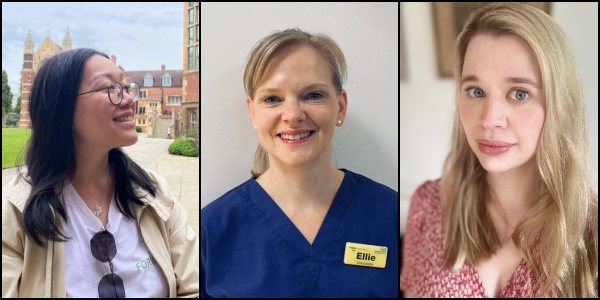
(From left) Winnie Tam, Eleanor Butterfield and Rose Hazell-Evans
The College of Radiographers has funded three radiographers to pursue doctoral research through the Industry Partnership Scheme’s Doctoral Fellowship Grant.
Winners of the Doctoral Fellowship Grant will receive up to £25,000 to support their doctoral research and be published in the Society of Radiographers’ peer-reviewed journal Radiography.
The winners, Eleanor Butterfield, Winnie Tam and Rose Hazell-Evans, have shared the details of their research projects and how they hope to support patients and their families.
Dr Emma Hyde, head of education and research at the SoR, said: “It has been a pleasure to award these three Doctoral Fellowships to Eleanor, Winnie, and Rose. Their research projects all have the potential to lead to significant positive changes to patient care within imaging and radiotherapy services. I will be keeping a close eye on their progress and look forward to seeing their research outputs in the near future.”
The College of Radiographers Industry Partnership Scheme (CoRIPS) funds projects related to any aspect of the science and practice of radiography, undertaken by radiographers at all stages of their careers. Find out more about the scheme online here.
Eleanor Butterfield, specialist radiographer at Frimley Health NHS Foundation Trust: Patient, Sonographer and Referrer experiences of Ultrasound in CDCs (LUCiD-US)
Eleanor’s application was for an ultrasound-specific fellowship, which was ringfenced for research in sonography supported by a retired radiographer’s legacy fund.
Her project will look at patient, sonographer and referrer experiences of ultrasound pathways in Community Diagnostic Centres. It will explore environmental and organisational elements as well as factors relating to the sonography workforce. This project will produce novel experiential data which will inform patient care pathways and future workforce sustainability.
She said: “I am delighted to receive this Doctoral Fellowship grant as it not only represents an important milestone in my professional journey, but will enable me to devote dedicated time to this research and attend a range of conferences where I will be able to share my findings with the radiography and ultrasound communities along the way.
Winnie Tam, PhD student at the University of Cambridge: Lung cancer Identification and Fairness Equalisation for Socioeconomic and Screening OPPORTUNITY Parity (LIFE OPPORTUNITY)
Lung cancer disproportionately affects people living in more socioeconomically deprived communities, but current risk prediction models used to determine who is eligible for screening could be underestimating risks in these groups.
Winnie’s research will evaluate how fairly these models perform across different populations and explore ways to improve equity without compromising overall effectiveness.
“This fellowship means I can spend less time worrying about how to fund my PhD and more time focusing on the research itself,” she said. “If there’s one thing I’ve learnt from the journey, it’s that if you really believe in your project, don’t give up after the first rejection, or even the thirtieth. There’s a Chinese proverb - ‘throwing an egg at a stone’ - and it is used to describe a hopeless task. At times, pursuing this PhD and fellowship felt exactly like that. But the small victories along the way taught me that, sometimes, an egg really can crack a stone.”
Rose Hazell-Evans, consultant radiographer at West Suffolk Hospital NHS Foundation Trust: Total Body PET for Renal Cell Carcinoma characterisation
Rose's research is exploring how advanced total-body PET imaging (supported by the National PET Imaging Platform) can improve the characterisation of renal cell carcinoma (kidney cancer). This is a feasibility study, but it has the potential to support better clinical decision-making, Rose said, for example by identifying patients who would benefit from earlier treatment, and reducing unnecessary surgery for those with less aggressive disease.
At present, it can be difficult to determine how aggressive a kidney tumour is before surgery using conventional imaging alone, meaning some patients undergo unnecessary treatment while others may benefit from more personalised management.
Rose said: “Receiving the College of Radiographers Doctoral Fellowship is an incredible honour and a real privilege. As a consultant radiographer, I'm passionate about improving patient care through research, and this fellowship gives me the opportunity to pursue that ambition while continuing to work clinically.
“I'm excited to explore how advanced molecular imaging can improve the diagnosis and management of kidney cancer, and I hope the findings will contribute to more personalised care for patients in the future.”
Find out more information about the CoR Doctoral Fellowship Grant online here.