
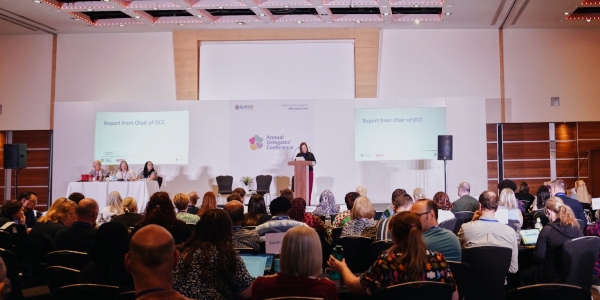
Day two of the SoR Annual Delegates Conference saw plenty of debate on topics important to members, including NHS uniforms and paediatric cancer care.
Taking place at the Novotel London West hotel in Hammersmith from April 27-29, the Annual Delegates Conference (ADC) is an opportunity for SoR members to steer the direction of the Society for the coming year.
A total of 30 motions were debated on the second day of the conference, alongside elections for key appointments within the Society.
The Annual Delegates Conference (ADC) is a yearly SoR conference that allows members to raise subjects for debate that will influence the SoR UK Council’s priorities, bringing together members, including regional representatives, regional and national officers and UK Council. It allows members to put forward motions for consideration by delegates, with carried motions being actioned over the following year by the Council.
Each Regional Committee and National Council sends elected delegates to ADC. The SoR equality network Equalise and the UK Council of the Society of Radiographers may also submit motions for debate.
Opening the second day
Following on from the festivities of the Gala dinner the previous evening, delegates returned to the conference hall bright and early for day two.
Proceedings opened with voting on conference elections, where several delegates put themselves forward for positions, including observers to UK Council and to the Delegates Conference Committee, which organises ADC.
Following the elections, Isabelle Parsons was elected to the role of UK Council student observer. John Kelly and Ramadan Haram were elected as observers to UK Council.
Comfort Ogunbanjo and Saraaz Khalilwere both elected to the Trade Union Education Committee. For the Delegates Conference Committee, Annabelle Young and Nkiruka James were elected.
Motons then got underway for day two. Motion 42, raised by delegates in the Northern Region, called upon UK Council to work with NHS Employers and national bodies to promote responsive, flexible, and compassionate leave policies for reservists and immediate family members. This motion was carried.
This motion was followed shortly after by motion 44 on the topic of pet bereavement leave, which sparked lively debate among delegates.
Raised by the Northern Ireland delegation, the motion called for UK Council to advocate for health trusts and boards to introduce a period of paid, compassionate/bereavement leave as part of a bereavement leave policy. However, after much discussion, this motion was not carried.
Motion 55 also raised another important topic for discussion on the training and education around care for paediatric cancer patients and their families.
Raised by the Midlands region, this motion called for UK Council to work in collaboration with charities and patient experience groups to ensure that providers of undergraduate therapeutic radiography programmes include at least one lecture focusing on appropriate care for paediatric cancer patients and their families within the course. This motion was carried.
Concerns around uniform policy
Staff uniforms were also a common topic throughout the second day. London region raised motion 46, which raised concerns about the cost of introducing new standardised NHS uniforms across England. The motion, which called for the UK Council to lobby NHS England to pause the proposed rollout, was not carried.
Motion 70 related to protecting people from harmful image-generating apps. Raised by SoR presidentKatie Thomson, the motion stated: “The safety and dignity of all must be protected in both physical and digital spaces. Image-based abuse is a serious safeguarding issue, with consequences for well-being, reputation, and personal security. Regulation and accountability are essential, as voluntary measures by app and software developers have proven insufficient.
“UK Council calls upon Conference to support advocacy for stronger legal and regulatory frameworks that address image-based abuse, digital manipulation, and non-consensual content.” This motion was carried.
The final motion discussed at this year’s ADC was motion 71, calling for the introduction of railcards for NHS professionals to support them in their commutes. This, this motion argued, would serve as a way to value NHS staff and help national environmental goals by promoting more sustainable transport methods. That motion was carried.
Susanne McCracken, the SoR’s vice president and chair for ADC, opened up day two of the conference.
She said: “I was so nervous leading up to the event, but everyone tried to reassure me that it’s such a friendly conference, and it genuinely is.
“The conversations have been interesting, the attendees have been amazing. It’s been a really enjoyable experience.”
On her highlights for day two, Susanne said: “The pet bereavement debate was very interesting. That was always going to get some interest.
“I just really enjoy having a bit of a debate, that’s the best part of ADC for me.”
The very final item on the agenda to close out 2026 was the Benevolent Fund Raffle. The SoR benevolent fund is a registered charity that exists to help members, former members and their dependents when in need.
This year’s raffle raised £706 to support the fund, with a variety of prizes on offer.
Richard Evans, CEO of the Society, gave closing remarks as 2026 marks his final year as chief executive, before handing over to Charlotte Beardmore in the autumn.
Find out more about the Annual Delegates Conference 2026 online here.