
.jpeg?width=1392&height=792&ext=.jpeg&width=900&resizemode=force)
Patients being tested for prostate cancer can now benefit from an innovative procedure implemented at Scunthorpe General Hospital.
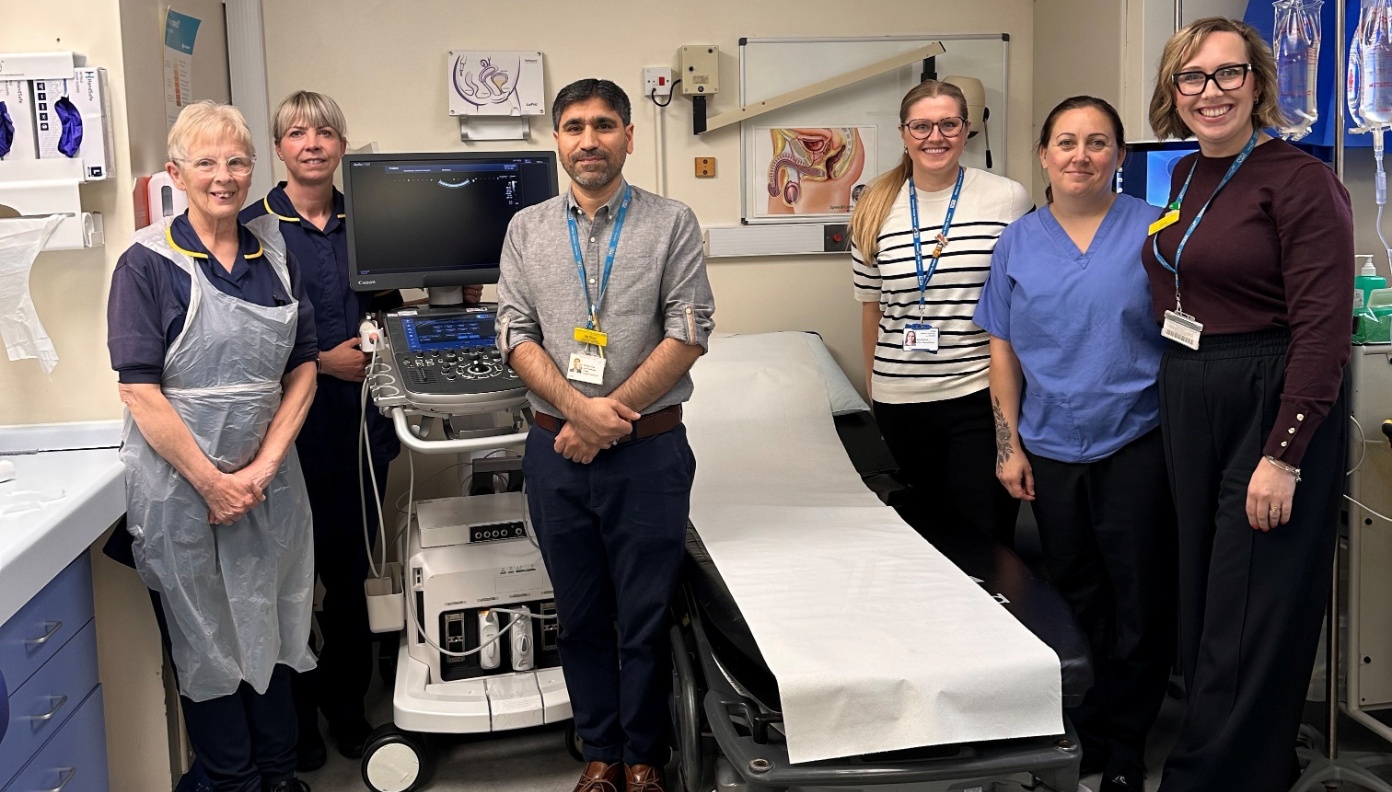
Official charity for Northern Lincolnshire and Goole NHS Foundation Trust the Health Tree Foundation have procured an important piece of diagnostic equipment, in support of the urology team providing patients with more accurate and swifter diagnostic tests.
The procedure, which is usually carried out under a local anaesthetic, is known as a transperineal biopsy, and uses an ultrasound probe which displays an image of the prostate on a screen.
Creating more equity
Use of ultrasound during the procedure means the biopsy can be taken with even greater accuracy, and result in a more precise diagnosis. Improved accuracy also reduces the risk of infection and the need for patients to take antibiotics following the procedure.
Olivia Laking, senior general manager for urology, said: “The team submitted a wish to our charity – The Health Tree Foundation – as we previously only had one of these machines at Grimsby. This meant patients were having to travel to Grimsby, and we wanted to create more equity for our patients and reduce their need to travel. This also means we have more diagnostic capacity to offer to our patients.
“The procedure is considered the gold standard for diagnosing prostate cancer. As well as allowing us to collect cells more accurately, the procedure also enables us to map the location and extent of any cancer which may be present. It also improves our ability to detect small cancers.”
'Such a great improvement'
Carly Stothard, senior service manager for the urology department, and project lead, added: “Patients are able to be diagnosed quicker and in turn, this means they are able to go onto the waiting list for surgery or for an oncology appointment much sooner. Our patients were waiting up to 21 days for biopsies previously, and we have now managed to reduce this to only seven days, which is such a great improvement for our patients”.
GPs refer patients with symptoms to the urology service, following various tests, before then being sent for an MRI. If the result of that is positive, they’ll undergo a biopsy.
Carly added: “We’re hoping in the future nurses and Allied Health Professionals (AHPs) will be able to perform the biopsy too.”
Scunthorpe’s urology team began using the new procedure in February 2026 and is expected to support around 500 patients per year with this technology.
Image: (From left) Sister Anne Whittingham, Sister Gill Clarke, Mr Israr Khan, clinical lead for urology, Carly Stothard, senior service manager, Leanne Batty, advanced healthcare assistant, and Olivia Laking, senior general manager