
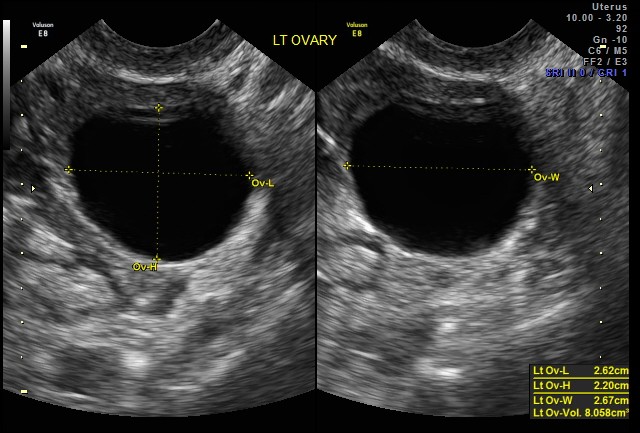
Sonographers should be aware of updated guidance from the Royal College of Obstetricians and Gynaecologists (RCOG) on the diagnosis and management of ovarian cysts in postmenopausal patients.
Guidance recommends no further action or follow-up for asymptomatic, simple, unilateral, unilocular ovarian cysts with a low risk of malignancy, and measuring 3cm or less in postmenopausal patients
The SoR and British Medical Ultrasound Society Guidelines for Professional Ultrasound Practice, 9th edition have been updated accordingly to include this important change.
Reducing the need for unnecessary exams
The update should reduce the need for follow-up scans and the associated anxiety that creates for many patients.
Gill Harrison, professional officer for ultrasound at the SoR, said: “This guidance is welcome news for postmenopausal patients. It can be a time of heightened anxiety waiting for follow-up scans. As evidence develops over time, it is important that guidance changes to reflect that and reduce the need for unnecessary examinations, all of which create anxiety.
“We are hearing evidence that this change is also impacting ultrasound services, freeing up appointments which enable earlier detection and diagnosis for patients with other conditions.”
Reflecting new guidance
For asymptomatic, simple, unilateral, unilocular ovarian cysts between three and five centimetres in the presence of normal serum CA125 levels, conservative management is recommended, with a repeat evaluation in four to six months.
The RCOG explained it is “reasonable to discharge these women from follow-up after one year if the cyst remains unchanged or reduces in size, with normal CA125, taking into consideration the patient’s wishes and surgical fitness”.
Should they prove symptomatic, further surgical evaluation would be necessary. Additionally, patients with a suspicious or persistent complex adnexal mass need surgical evaluation. Sonographers’ reports should reflect this new guidance.
Find the updated guidance in full online here.
(image: Ultrasound of left ovary with follicle, via the SoR)