

The Society of Radiographers has published leading statistics from the upcoming 2025 Ultrasound Census, revealing that the overall sonography vacancy rate has risen to 24.2 per cent.
Taking place between December 2024 and January 2025, the 2025 Ultrasound Census aimed to gather information on the number of working sonographers, vacancies and the larger workforce structure.
Headline statistics include the rise in sonography vacancy rates, which are up by 11.6 per cent since the last ultrasound census in 2019 and 6.1 per cent from 2014. Respondents pointed to recruitment difficulties as the main reason for this.
Gill Harrison, SoR professional officer for ultrasound, said the census results are indicative of ultrasound services across the UK: “This evidence will be crucial in national discussions about workforce shortages, education and training needs, and the urgent requirement to improve sonographer career pathways, particularly in some areas of practice such as obstetric and gynaecology ultrasound and paediatrics.”
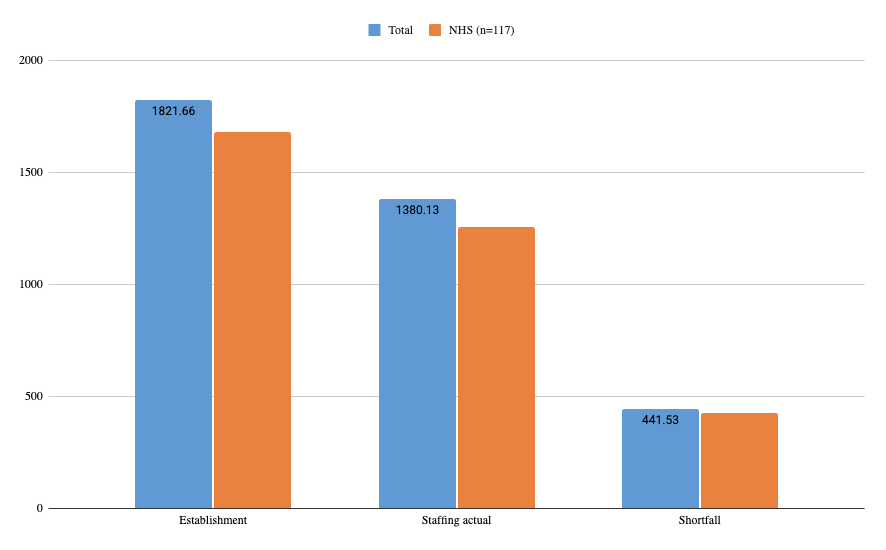
Figure 1: Establishment, actual workforce and shortfall of sonographers (n=153)
Effect of workforce shortages
The SoR routinely carries out workforce surveys, targeted at managers in various areas of the profession, to inform the work of professional bodies, workforce planners and commissioners/providers of radiography and sonography education. Previous ultrasound censuses were published in 2019 and 2014.
In total, the 2025 ultrasound census gathered 161 responses from 142 ultrasound providers across the UK - more than double the 2019 response rate. 153 responses were included in the analysis after data cleansing.
The census results disclosed that vacancy rates differ between the NHS and the independent sectors, with the percentage totalling at 25.3 per cent for the former and 11.6 per cent for the latter.
The SoR has long been attentive to workforce shortages across imaging. In response to sonographic staffing shortages and changes in education, last year the Society published case studies on how to increase ultrasound clinical training capacity.
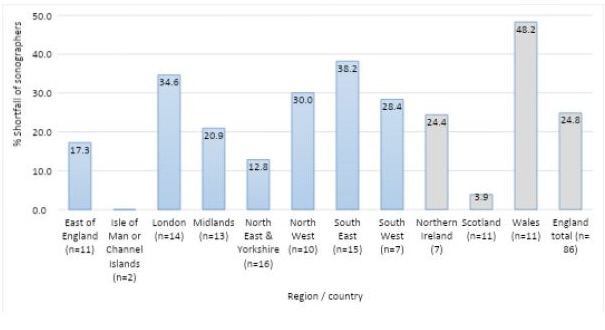
Figure 2: Percentage shortfall of sonographers (WTE) by region and country (NHS only)
Census responses also revealed that close to a quarter of staff absences are due to work-related issues, such as stress or work-related musculoskeletal disorders. In terms of sonographers leaving the profession over the past 12 months, the most common reason given was ‘other’, followed by retirement. Other reasons given included relocation, career change and maternity leave. Increasing numbers of sonographers are planning to retire within twelve months of the census (7.6 per cent, up from 4.6 per cent in 2019).
There were a number of common concerns cited when it came to questions about recruitment, retention and wider workforce issues. Respondents named low pay, limited career progression and superior opportunities in the independent sector as sources of contention.
‘Attract, recruit and retain’
In terms of staffing, Gill explained that sonographers must be incentivised to join and remain within the ultrasound workforce.
“It is vital that policymakers work with stakeholders, including the SoR, to attract, recruit and retain highly skilled sonographers,” she said. “While we continue to lobby for sonographer regulation to protect patients and expand educational and career pathways, additional measures are needed to ensure existing staff can thrive.”
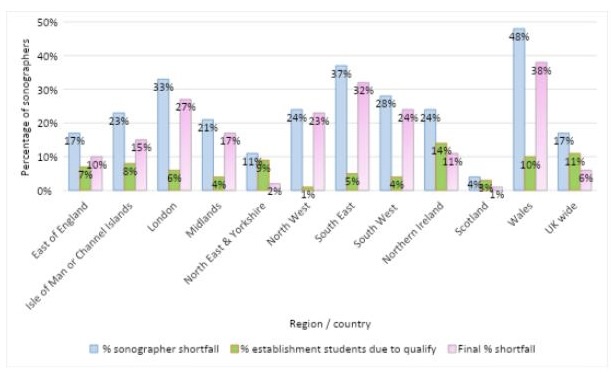
Figure 3: Current sonographer shortfall by region or country, alongside trainees due to qualify from CASE accredited programmes within 12 months, expressed as a percentage of the established workforce. The overall shortfall is presented, assuming trainees qualify and remain in the region as full-time staff
The full 2025 Ultrasound Survey will be published on the SoR website in the coming months.
Image credit: Eva Slusarek