
In this section
In This Section

🎓What are T-Levels?
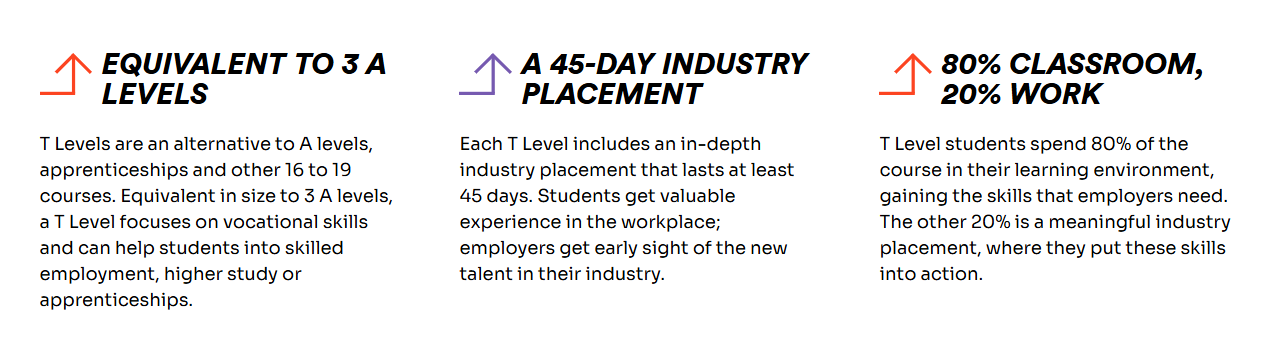
T Levels are exciting two‑year courses you can take after your GCSEs. They’re the same level as three A Levels but are built differently — they combine classroom learning with real experience in the workplace.
These courses have been designed with employers and industry experts, so what you learn genuinely prepares you for jobs, apprenticeships, or higher education.
You’ll spend time learning in college and completing an industry placement of at least 315 hours (around 45 days) — a brilliant chance to try out the job and build confidence.
T Levels are available at selected schools, colleges, and providers across England.
🔧Are T Levels the Same as Apprenticeships?
Not quite — but they’re closely connected.
- T Levels: More classroom‑based, plus a substantial work placement.
- Apprenticeships: Primarily work‑based, with training on the job.
T Levels are great if you want practical experience but also want the structure of learning in a classroom. They’re designed to help you step confidently into the workplace, an apprenticeship, or further study.
🩺T‑Level Qualifications for Health Careers

The T Levels Advantage: A Journey to a Career in Healthcare
If you're interested in becoming a Support Worker, or pursuing a role in health, T Levels can be a perfect match.
It’s recommended that students choose a T Level in Health to gain the knowledge and skills needed for support roles or entry to university programmes.
A key update:
- Enrolment onto the Healthcare Science T Level ended after the September 2025 intake.
- From September 2026, students interested in assisting healthcare science roles will pursue the T Level in Health instead
🎓UCAS Points and Higher Education
Good news for students considering university — T Levels come with UCAS tariff points, and you’ll get a score based on your overall T Level grade. You must achieve at least an overall Pass to receive points
Here’s how T Level grades compare:
Many universities now accept T Levels. You can find a full list of participating institutions on the government website.
| UCAS tariff points | T Level overall grade | A level |
|---|---|---|
| 168 | Distinction* (A* on the core and distinction in the occupational specialism) | AAA* |
| 144 | Distinction | AAA |
| 120 | Merit | BBB |
| 96 | Pass (C or above on the core) | CCC |
| 72 | Pass (D or E on the core) | DDD |
You can find a list of higher education institutions who accept T Levels for entry onto one of their courses.
 Stories from T-Level students
Hear directly from students who are taking their T Levels about why you should take the next step.

Visit T-Levels website
Learn more